Monday, January 18, 2016

Western Art at the Tacoma Art Museum

During our visit to the Tacoma Art Museum, we learned that what constituted "the West" changed over time as the country continued to expand westward.

We looked at line in this painting, Supreme Moment of Evening, by Curt Walter and discussed how we could tell what the artist felt about his subject, the Grand Canyon, and the different tools he used to make it look so dramatic. We noticed the colors and the light, and paid particular attention to the horizon line.
 
We made a diagonal line with our bodies to show the line separating the foreground from the background in this painting:


 Then we looked at this painting, Rain and Runoff, by Ed Mell, and compared and contrasted the  portrayal of the subject and the different styles and overall feelings conveyed in the two paintings.


We also looked at When The Plains Were His by Charles M. Russell, and noticed the details of the Native American dress and discussed what was happening in this painting (the displacement of Native Americans) and why this was happening.


We ended our time in the gallery with a kind of scavenger hunt, looking at other art works. My group was drawn back to Charles Russell's sculptures, which we had studied previously with Ms. Head at school.


 We discussed the following questions as we looked:


Then, led by a very congenial group of high school students from the School of The Arts, we tried our hands at our own western landscapes using watercolor pencils.


 These turned out beautifully (not that I'm biased or anything.)


Here are the things that made the biggest impression, as we wrote our thank you letters:


I'd heard the western collection at TAM was pretty amazing, and it truly is! Thank you, Tacoma Art Museum, for sharing it with us!

Sunday, January 10, 2016

First Friday: Building

We just completed our first cycle of "First Friday" enrichment classes. First Friday brings the Middle and Lower schools together for a whole school gathering, presentations by different classes, and a joint recess before students of all ages break into different groups to rotate through a cycle of special classes. This year's first cycle has included cooking, a mural art project based on the Peter Reynolds book The Dot (these have turned out beautifully and are hanging in the Lunch room/Computer Lab if you want to take a look - see the Ladybugs blog for pictures of the work in progress), origami, reading and building.


In my room students have been building whatever they can imagine using a variety of materials: different types of blocks, Legos, straws, marble runs, Magformers, etc. The only rule is that you find someone in a different class to work with and, of course, that you clean up after yourself when you are done.

Students pick any material or combination of materials they would like and get to work. The best part about this exercise is seeing the creativity and collaboration develop between middle schoolers and preschoolers and all ages in between. It is also fascinating to see how one material can be used in many different ways or capture the imagination of a whole group. Last year, I saw some amazing marble run creations materialize; this year the building straws have reigned supreme.

We had a straw arch, a building that just about reached the ceiling, and creations that started with two kids and drew most of the group into the building process before the period was over. I loved seeing Pre-K students ask tall middle schoolers to help balance them on chairs, and fifth graders helping kindergarten and second-graders solve design challenges. ("This ramp isn't working!" "Have you tried this?")

As Ms. West (Ladybugs teacher) said in her blog, there's magic in the air during these classes. The room is quietly buzzing with ideas and imagination at work. There's a lot of social learning around sharing and working collaboratively, and it is amazing to me how little teacher interaction is needed to solve issues when kids are truly engaged in creating -- they work most of the problems out themselves in the interest of completing their project.

There's also an incredible amount of spontaneous math and science learning that happens. Different kids had fun calculating how many cubes were in each straw shape and the different ways to figure that out, thought about gravity, thought about the relative strength of different shapes, thought about angles and the ways shapes fit together.  In the last class, one student constructed a model of the solar system using marbles and different pieces from different sets, including a plastic cup representing the rings of Saturn.

First Friday classes are always fun, always enriching, and also enlightening. It's one of my favorite days at school, and I don't think I'm the only one who loves it!


A little organizational challenge from one group of students to the next.


Some serious concentration can be required.

This one almost reached the ceiling. note the extra support at the base.


Simultaneous building from he top and bottom.


More Meteorology: Wind

We've been learning about wind as part of our study of Meteorology, and the Pioneers love Bill Nye, so we always look to see what he has to say on our subject of study. We recently watched this video (among others) to learn about how wind works:


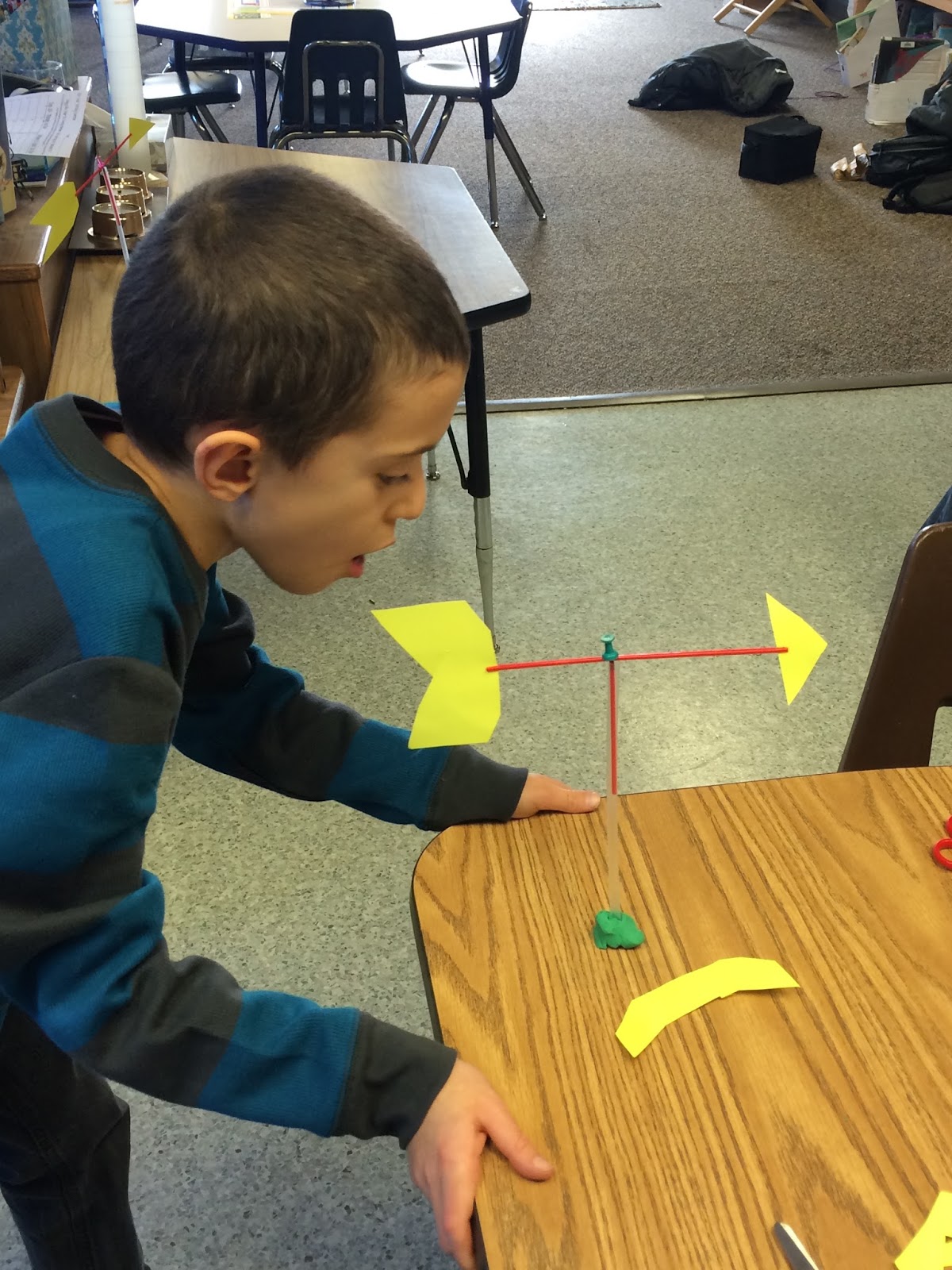
Then we talked about how we can find out what direction the wind is blowing when it is invisible, and decided to make our own wind vanes to measure wind direction:


 The balancing part was difficult, as was getting the pushpin through the middle of the straw.


Up next: An inquiry investigation using some of the tips and tricks we learned here to make our own anemometers to measure wind speed!